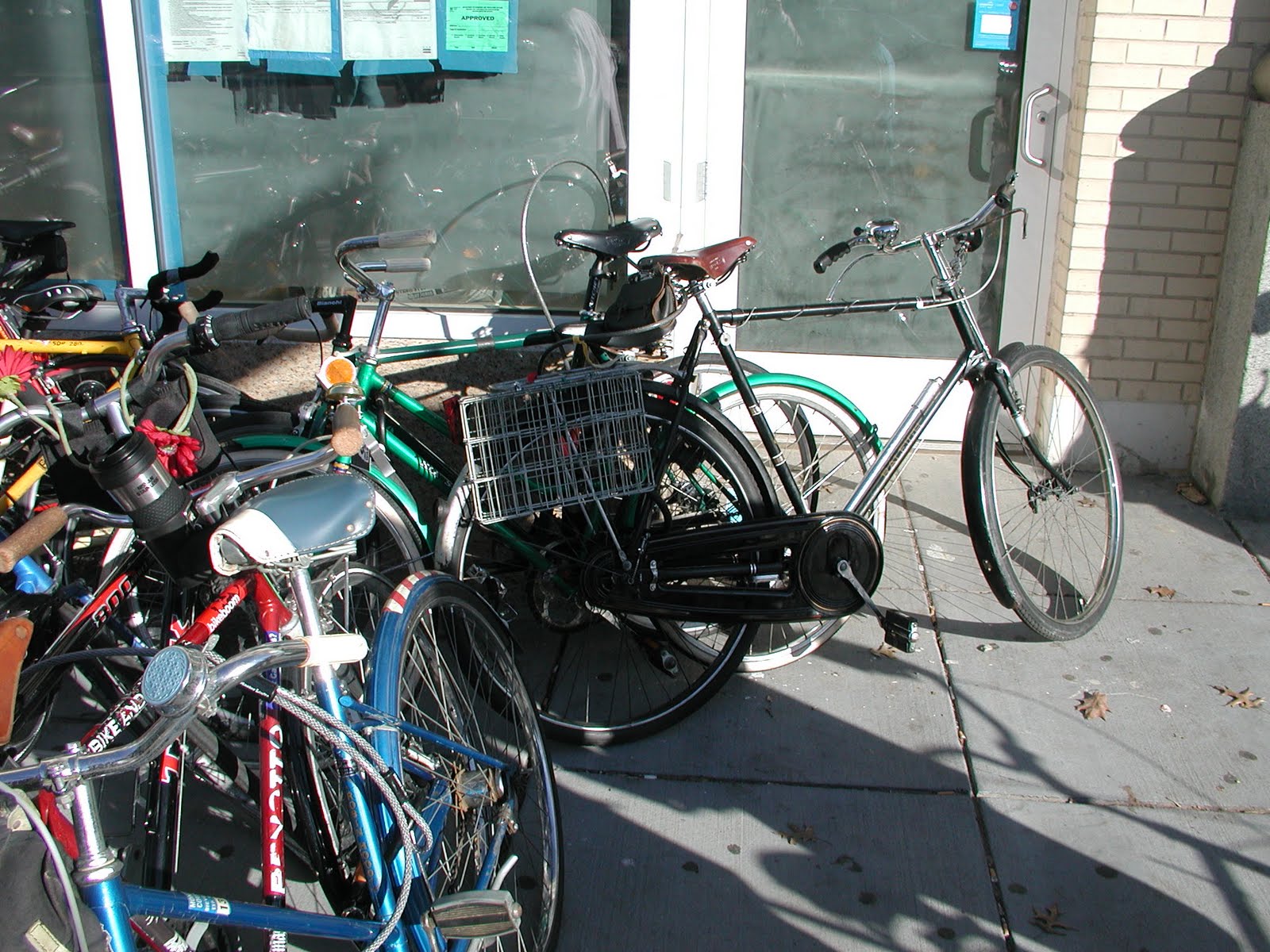
Friday, October 6, 2017

On Three Wheels, Again

"Time flies like an arrow. Fruit flies like a banana." -- Wallace Tripp

My riding (and writing for this space) had dropped off to nothing, or statistically close to it. I have all the usual excuses. They had a lot to do with starting a new phase of my real estate career which took more of my time, and riding instead of driving to somewhere I was going anyway (which has always been the way I got in the most riding) not being so convenient as it had been. The result being that I am in about the shape I was in a decade ago when I resumed bike commuting, and most of the progress I had made was lost.

So I'm starting over. And it happens that I have also made some changes to my velocipedic fleet. I am down to two bikes and a trike now. I have kept the 1986 Raleigh as my one "normal" bike, and my Dahon Speed TR as my touring, load-carrying, errand-running, all-purpose bike (it can go up anything, carrying everything). And I inherited another trike.


Wednesday, April 4, 2012

Opening a New Folder

Bicycling means freedom. I decided that when I learned to ride one at the age of seven. I was allowed go anywhere I could ride to, as long as I got home in time for dinner. It was not only my first taste of mobility, it was also the first athletic activity at which I was any good, and it's still in the top three. 

Folding bikes, because they can be taken with me to places I would otherwise not have a bicycle, extend that freedom. For that reason, they have long interested me, and I've owned several. To me, the ideal bike would fold small enough to carry with me anywhere like a cell phone, and have the capabilities of a full-size bicycle. We're not there yet. Probably we'll never get there. Folders usually compromise on rideability or portability to favor one over the other. Those that compromise less are generally expensive. The choice is thus based on the rider's intended uses and budget. 

A while ago I began looking for a folding bike that could replace my non-folding bikes. There were several points of origin for this, in addition to the reasons already given. It was a continuation of my search for the one bike that could go anywhere and do anything. A few years ago, I read accounts by the late travel writer and touring cyclist Eric Newby of his experiences touring on Moultons, of which he was an early adopter and advocate. He wrote of the advantages of small wheels and low centers of gravity. But Moulton bicycles are seriously expensive. What might do the same job for less money? In 2009, I had started building a Surly Cross Check in a touring configuration as the bike I would use for everything and take everywhere, including on travel. That summer, while recovering from a broken elbow, I started riding a recumbent trike that had 20-inch (BMX size) wheels. It has a wider gear range than models with larger wheels, and the wheels are easy to store, transport or change tires on. As I resumed building the Cross Check in 2010, I happened upon Surly's rationale for using 26-inch (MTB) wheels on their dismantleable Long Haul Trucker: the wheels allow it to fit in an airline-standard case, and the tires are readily available worldwide. With the airlines becoming stricter and charging more to carry bicycles, traveling with a standard bike can get expensive. And I noticed that the price of such a bike was getting up there with the better folding bikes. While last year I was considering which of these I would like, a 2008 Dahon Speed TR turned up on Craig's List at an attractive price. Within 20 minutes the deal was done, and the next day I collected it from the seller. Very soon after, I brought it on a trip to New England. 

The surprise has been how completely it replaced my other bikes. The Surly is still unfinished and I plan to sell it. I'm debating whether to keep a standard bike at all. Admittedly, my old drop-bar Raleigh is about ten pounds lighter, and has the classic look that I still identify as what a bicycle should look like. But I still don't ride it much any more. Sometimes I wish I had drop bars on the Dahon; they could probably be fitted, but I'd lose one of its advantages for urban riding, which is that all the controls can be accessed without changing hand positions. I wouldn't use the Dahon for racing, but I don't race anyway. Dahon lists this model as a loaded touring bike, and I'd use it for that. Loaded with full touring bags, it has better balance and handling than the custom-made touring bike I built 38 years ago, which disappeared from the garage where it was stored in 1987. Thank goodness, I can stop missing it. 

I've ridden it on everything from big urban group rides to unpaved woods trails to frequent grocery-shopping trips. So now I have a folding bike that can go almost anywhere and do almost anything. What adventures would I like to take it on? 

Monday, November 7, 2011

2011 DC Tweed Ride set for November 13

The Dandies and Quaintrelles have announced Sunday, November 13 as the date for the third annual DC Tweed Ride. The ride is free, but there is a $15 charge for the after-ride party. The space for the party is too small for the number of people likely to be on the ride, so they're encouraging pre-registration to make sure you get in.

You can see yours truly in the lower right corner of the photo collage for the ride announcement, riding my Trice recumbent trike in the 2010 event. With the only recumbent and only trike, I got more attention than with the Raleigh Roadster I rode in 2009. Not sure whether I will ride the trike this year or the Dahon folder that I have recently been favoring for urban settings.

Friday, July 8, 2011

Redundancies and Solecisms

Since I monetized my blog (sold out to greed and corporate interests) by allowing Google to place ads on it, which so far has netted me about $3.47, I'm looking at what ads show up. I sold ad space for 20 years, and take a professional interest. The process of ad placement on the page is entirely automatic, based on the content of my posts. So the one I just posted mentioned trikes, and an ad for "three wheel trikes" showed up. I wonder what other kind of trikes there might be besides ones with three wheels. People just don't pay attention to language. Quite often when I am out on a ride on my trike, passersby will call out, "nice bike!" This is of course inaccurate, since bike is short for bicycle and by definition, means it has two wheels. Sometimes I correct them. More often I just seethe inwardly. As a regular reader of Craig's List, I've also noticed that "recumbent bike" to many people means a type of stationary exercise equipment that has no wheels at all and doesn't go anywhere by means of pedaling--though perhaps it goes somewhere by peddling, which is why it's on Craig's List in the first place.

Live Free and Die

On a trike riders' forum I subscribe to, the perennial subject of whether bike helmets increase safety has come up. Someone complained that their head gets hot when they wear a helmet, and suggested that on a trike, which doesn't require balancing, helmets might not be necessary. Then everyone else had to weigh in. It occurs to me that while a trike doesn't fall like a bike does, it can flip (I have lifted a wheel a few times in fast cornering), and if it did, it is perhaps likely to land upside down.

What color is your helmet? I wear a white helmet, which is noticeably cooler (in temperature if not in appearance) than the dark green helmet I used to wear. It is also more visible, which could be helpful--and I have front and rear lights on it, originally for better visibility as my head is higher up than the trike (or bike), and has the additional advantage that whatever bike or trike I'm riding, I have lights.

Back when bike helmets first appeared, we all thought they looked dorky and resisted wearing them. Since then they've been styled more attractively, and we've gotten accustomed to wearing them. I wear mine almost every time I ride, whether on bike or trike. Better to be a live dork than a dead hipster. The debate over whether they really make a difference is more about people resisting the "domination" of wearing a helmet. Last week a motorcycle rider in an anti-helmet protest group ride fell off his bike onto his head (at low speed) and was killed by head trauma. There were people commenting approvingly that he died for his freedom. Personally, I think there are freedoms more worth dying for than the right not to use a piece of safety equipment. The thing is, you won't know if it makes a difference until you are in an accident, by when there is nothing you can do about it.

Saturday, June 4, 2011

Seersucker Style Today

Has it really been seven months since I posted anything here? Time flies whether you're having fun or not. Speaking of having fun, today is the second annual Seersucker Social ride, lawn party and after-party. I'm going. Perhaps, the thought arises unbidden, I ought to be working. So I'll give out business cards and claim it was some kind of work.

Last year I rode my Raleigh DL-1 Roadster that had also been my steed on the first Tweed Ride. However, that bike went to its new owner last week. While I really liked the Roadster, it was a favorite bike that I rode only about three times a year. So this year I will ride my recently-acquired Dahon. This has the advantages of plenty of gear range (something the roadster definitely did not have), and easy portability to get to and from the venue (which since I sold my Volvo wagon last year, the roadster also did not have). I have a morning event to go to at Landmark Education, so I'll take the bike in the car, park by a Metro, and take Metro to the starting point.

As the Dahon lacks the full gear case of the Roadster, style will be compromised somewhat with practicality--which means I'll wear shorts instead of trousers. But they will be seersucker!

Seersucker, by the way, has nothing to do with Sears (as I once thought). It is an Anglicization of Farsi words meaning "coffee and sugar" and referring to the alternation of dark and light colors and different textures in the fabric. It probably originated in India and first came to the attention of Europeans through the Middle East centuries ago. Its coolness and style have long been appreciated in warm weather. While today's forecast is not as warm as last year's (which was like cycling in a sauna), it will still be a pleasure to stay cool and look good at the same time.

The Dandies and Quaintrelles, organizers of the ride, have as their motto, "Redemption Through Style." Put your trust in seersucker, my children, and ye shall be redeemed!

Friday, December 3, 2010

Tweed Ride Coverage on Russian TV!

There was a camera crew filming the Tweed Ride on November 14th, and while we were in front of the White House I noticed them filming me. One of them spoke to me with what sounded like a British accent. Next day this clip was on the Dandies and Quaintrelles web site. I'm in the clip, near the end. As the only recumbent and only trike on the ride, I got more attention than I got last year riding my Raleigh Roadster, which was theoretically more in keeping with the event.

Saturday, November 13, 2010

Time Flies Like an Arrow

It seems like no time has passed since the Seersucker Social in June. The 2010 Tweed Ride is tomorrow. I've been so preoccupied with working that I hardly paid this any attention.

I was the last rider on the Seersucker Social. I'd had some mechanical difficulties with the Roadster. The gear case, installed for the Tweed Ride, had come loose and needed to be secured. I did this, then set off with the bike in my Volvo 240 wagon, intending to take Metro part of the way. When I got the bike out of the car, it was clear that something was wrong--the chain had come off the chainring and was jammed inside the gear case. There was nothing for it but to return home and sort it out. By then my margin of time had disappeared. I got to the start after everyone had left and followed the route by myself. I arrived just in time for the last of the drinks.

It was growing dark by the time I left, and I was glad of the dynamo lights on the Roadster. Next day the Roadster's back tire was flat. Four months later I still haven't fixed it. Gear cases are great for keeping your clothes clean, but terrible for removing wheels!

Now the 2010 Tweed Ride is tomorrow, I still hadn't fixed the tire, and I hadn't even really committed to going--I told myself that my business took precedence, and booked an appointment for 4 p.m. in Alexandria. Then tonight I asked myself if I could do both. The answer is yes, if I do two things that run contrary to form: get an early start and leave before the party is over. I can ride the Trice, which goes well with tweed and handles long rides and hills better than the Roadster does.

Friday, June 11, 2010

Seersucker Social June 12 in DC

I've been neglecting my blog for a few months while dealing with health, weather, and business, and I've had a nasty cold for the past week, so here this is, almost last minute. 

The Dandies and Quaintrelles, who brought us the wonderful and wildly successful DC Tweed Ride last November 15, are having their second event, the Seersucker Social, on Saturday, June 12, starting at 3:30 pm, with a reception afterwards at the ride destination Hillwood Estate. More than 450 people attended the Tweed Ride. Registration is free for the ride itself and $20 for the after-ride party--including food and drink. Having spent the week resting up and recovering, I plan to be there with my Raleigh Roadster. 

Saturday, March 27, 2010

A VASA Difference

Time flies whether you're having fun or not. So it's been weeks since this event that I'm only writing up now. The Embassy of Sweden hosted a ride on March 7th, in celebration of a famous Swedish ski race and festival, Vasaloppet. How could a Volvo-driving, IKEA-shopping cycling nut like me resist? Only thing was, the start time for the first ride was (ugh) 7:30 a.m. I planned on going on the second ride at 8:30, and set my alarm for 5.

Three rides were offered: 56-mile out into Montgomery County, 31-mile along the Potomac shore, and 15-mile through downtown DC. I thought the 31-mile ride looked both interesting and manageable for my state of tune. However, while I did indeed get up and get ready, I got halfway to the start and realised I'd left my wallet at home. Then I realized I needed a layer to keep out the wind. So it took me three starts to get there and it was 8:45 when I arrived. 

I had signed up for this with no real idea of what the turnout would be--and this is only about my fifth time on a group ride of any kind. A solid wall of bicycles greeted me at the start. I heard later that there were 650 people on this ride, and most of them seemed to have opted for the DC route. At the sign-in table, they told me I was welcome to ride the 31-mile route, but I'd be following the group. I figured that I could always ride by myself, and I'd ride the 15-miler with the group that was there. I had thought, looking at the route map, that it would be too much like my recent urban rides around Arlington, and not enough of a workout. However, it was an interesting route, and it was enough of a ride for the shape I was in, especially when I added on getting to the start and home, which was another 15 miles or more.

At the end, the Embassy served us warm blueberry soup. It was a perfect after-ride refreshment for a chilly morning. I took a few pictures; they show a lot fewer people than were there because I took them late in the day when many riders had already left. 

While the majority of the riders were on upright bikes, there were several recumbents and one or two other trikes (I know a Catrike was on the ride and I saw a Greenspeed afterwards). In conversation with one of the recumbent bike riders, I mentioned this blog and gave him the URL--and found out he reads it. I'd never met him before. It was a great moment. Sometimes I have no idea whether anyone's really out there. Nice to find out someone is. 

Saturday, February 6, 2010

After the Blizzard, A Trike Ride

The region has just had a blizzard even bigger than the one in December. It snowed here from Friday midmorning to Saturday late afternoon, with reports of more than 30 inches in some places. Having been indoors for about 24 hours, I ventured out for a look around this evening. My intention was merely to get outside in the fresh air and see the snow from closer than my third-floor windows. I had no intention of riding. Then I had a look at my car, barely recognizable under the snow. Then back to the garage. A lane had been plowed through the parking area, leaving a layer of snow and ice where the plow had been, and a snow dam about three feet across and knee deep in front of the garage doors. I opened the door. I looked at the Trice. I looked at the snow. I kicked snow out of the way in a path just 30 inches across (the width of the Trice QNT) and rolled it out. Put up the flag, light the lights and set off down the parking lot. One trip down and back was enough to put a grin on my face and to show that while it was possible to ride on this stuff, it didn't take much for the rear wheel to lose traction. It was time to try out an idea I'd had during the previous snow rides. Tire chains for bikes have been made from time to time, but they were never a complete success and none are currently available. I'd had a simpler idea: a length of cotton clothesline, wrapped spirally around the tire and rim, ought to give sufficient extra traction. A few minutes later I was trying it out. It made a huge difference. I was limited now only by the depth of snow not exceeding the trike's 3-inch ground clearance. The thin layer that remained after plowing was no problem. The slipping and sliding just added to the fun; it was always under control. What was a problem was the 27-degree temperature and my lack of adequate head and face protection. I rode around until my face got too cold and came back in. My camera batteries were charging so I didn't have any pictures. I'll try this again tomorrow and take some. Trikes rule!

Monday, December 21, 2009

Trice on Ice

I've heard a lot about trikes being fun to ride on ice and snow. I've seen blog posts from a guy in Minneapolis who commutes year round on his, with a studded rear tire for the winter. I was wishing for some snow to try mine out in. A few weeks ago we had a little snow that melted off the paved surfaces almost immediately. I felt disappointed. Last weekend we had the largest snowfall I have ever seen in 22 years of living in this area, and reportedly the third largest in this area since records have been kept. In my neighborhood, it was up to two feet deep, though the actual amount that fell was probably less, as there was a lot of wind, producing snowdrifts. This seemed to be in the category of being careful what you wish for. I only wished for a little snow. Next I'm wishing for only a little money.

Anyway, even before I started to dig my car out, I had the Trice out of the garage. There was a snow dam about 18" high and wide in front of the garage door--the snowplow passing through the parking lot having taken out the rest. I lifted the trike over that and placed it in the plowed area. As this was only about a car wide, I had to move the trike to allow cars to pass. I sat down and began to pedal. What I found was that on an icy surface or in thin snow or slush, it would get traction and move. More than a couple of inches, and the wheel would just spin. With the standard Schwalbe Marathon Racer tire on the back, this was about what I expected. I would need a treadier tire if I did this regularly. Also, Trice recommends moving the seat toward the rear to increase the weight over the back tire for riding off-road and this would be much the same. However, I was riding back and forth in the plowed section. When it slid sideways, it was easy to correct and added to the fun. The Trice Q series have only a 3.2" ground clearance, and the rear derailleur on any 20"-wheel Trice is very close to the ground, so I got stuck in the unplowed snow.

I made my way from the parking lot around to the street. Bad idea. There was only one plowed lane and it was full of moving cars. There was no way to reverse course to get out of there. It was forward or nothing. I continued around the block and found that the side street was even worse. It was covered in enough slush to bog down in, and there were enough cars trying to use it that I had to stand up and move the trike out of their way several times. I was able to ride it short distances, then it would get stuck and before I could get moving again, along would come another car. I walked along pushing it through the worst, then was able to ride the last part and into the lot again. If I had some momentum, I could blast through places where I would not have been able to start from stopped.

After a couple more passes up and down the parking lot, I considered my point proved and put the Trice away. If I were going to ride in snowy conditions regularly, I might perhaps want a Trice T 26 for its higher clearance, with some knobby or studded tires on it. However, the QNT proved that it could be ridden on moderate surfaces, and in conditions where I would be a lot less confident on a bicycle, and it was a lot of fun to ride. I plan to do this again, preferably in better locations to do it in than one full of motorized traffic.


Saturday, December 19, 2009

Yes, I do get to commute on it occasionally


Last Monday it was six months since the bicycling accident in which I broke my elbow while attempting to ride to my office (June 14, 2009). The following day, December 15, I rode my Trice recumbent trike to the office. It was actually the second time I had ridden the trike to the office, having completed a full round trip on September 16. I don't often ride to the office, because in my business I usually have to be prepared to go out and show houses and I need to have a car with me. On this most recent occasion I was actually retrieving a car I had left at the office. I had been playing musical cars getting them into and out of the tire store before Thanksgiving, and had left the Volvo 240 wagon at the office for about a week. This meant that if I did get one of those emergency calls, I could drive there. I had a change of clothes with me and I was able to look presentable for our semi-monthly sales meeting. Tuesday was a good day to ride in because on the day of sales meetings we always have breakfast there. Plus I have to admit it was fun to show the Trice off to my colleagues.

Thursday, November 19, 2009

The Tweed Ride, A Personal View

The major and minor media having reported in, now it’s my turn. Sunday morning I was up very early to make sure the Roadster was ready. I adjusted the brakes, replaced the broken wire from the dynamo to the headlamp, and went for a test ride. A cacophony of noises rent the air. Roadsters are noisy anyway, but this was worse than before. The crank rubbed against the gear case. The gear case acted as a resonator to amplify every creak and chain rattle. I did what I could with the gear case and figured I would have to live with it. It would be like having loud pipes on a motorcycle. Most important, I found I could ride it with an acceptable level of elbow pain. This would be my first ride on an upright bicycle since the bike accident in June in which I had broken my elbow, and I was concerned about it. Given the condition of the bike and my arm, I chose to minimize the amount of riding to the event itself. I put the bike in my Volvo 240 wagon and drove it to a parking spot near a Metro station. That way, if the bike broke down or my arm started to hurt excessively, I could count on getting home. I have rarely taken bikes on Metro and finding the right elevators took some additional time. What with making sure the bike was ready and taking Metro on a Sunday, it was 12:30 when I reached the starting point for an event which had been scheduled to start at 11. Fortunately, I had seen a message from the organizer Eric that due to the large turnout, it would be run in groups over several hours. I arrived just as a group was leaving, registered, talked with people, took some pictures and had my picture taken, and was in what turned out to be the last group to go. Eric asked for leaders and I ended up as one of them, but I let my co-leader, who had done this sort of thing before, do most of the navigating. I found that the Roadster, which is not exactly a thing of blinding speed, was nevertheless so high-geared that even pedaling very slowly and coasting a lot, I kept getting out in front. At one point, not being used to riding in a group, I failed to notice I was crowding a lady behind me toward the curb, but did manage not to run her into it. Eventually I dropped back into the pack for a while. The ride was fun. The roadster’s loud bell received many compliments. The weather was really a bit warm for tweed, the best day we’d had in some time. We got a lot of attention and even some cheers from people along the way. At one point, a lady riding behind me commented on the noises my bike made. “When you changed gears, it sounded like your chain was falling off!” she said. I told her that the noises are what holds the bike together. I’ve gotten used to the many distinctive sounds that roadsters make. Actually I was pleased that the noise level was a lot less than it had been during my morning test ride. Inexplicably, the crank arm wasn’t rubbing on the gear case any more. I was having a great time and it was the perfect bike for the occasion. Roadsters are a hoot and a half. I can’t help grinning while I ride it. On arrival at Marvin, the venue for the post-ride party, we found that several hundred people had preceded us. The bike racks provided by WABA for the occasion were already full. Three of us locked our bikes together instead. I was so intrigued by the bikes parked outside that I did not get indoors where the party was for some time. The main party was on the upstairs deck. It was jam-packed. At the far end was some free food, if you could get there. Eventually I did. It was English muffins, eggs, grits, and English-style (meaning not cooked to a crisp) bacon—just the way I prefer it. The remainder of the day was spent in conversations, meeting new people, sampling Belgian ale and generally enjoying myself. I stayed longer than I thought I would have, and was glad I had made sure I had working lights for the return trip. I had also found that while my recumbent trike riding had maintained my stamina, I was no longer acclimated to a saddle after five months not riding an upright bike. This, however, did not become noticeable until the ride home. I enjoyed riding with a group (nearly all of my decades of cycling has been solo). I liked seeing the variety of bicycles and costumes. I especially enjoyed the feeling of camaraderie, that we were all in on something remarkable. I made some new friends and saw a few people I knew. Earlier in the day, one of the participants had been hit by a bus while riding to the start—fortunately she was not seriously injured and able to continue. At the end of the day, as I was getting ready to leave, I found out that a bike had been stolen from one of the participants. Because the racks were full, she had parked it separately from the main group, locked to a fence around the corner, where it was out of sight and easier to steal. It was perhaps inevitable that so large a food supply would attract predators and scavengers. Still, it was one of those things that takes a bit of the bloom off an otherwise perfect day. It’s a reminder that cyclists can never relax their vigilance for traffic hazards or theft. Those are the thorns on the rose. For some people, they are reasons not to ride. For others, they are occupational hazards that will not prevent them from enjoying the benefits. The rose smells sweet and looks pretty even with its thorns. Congratulations to Eric and his cohorts for a successful event, and I look forward to more great things from the Dandies and Quaintrelles.

Monday, November 16, 2009

Installing a Gear Case, or Is All This Work Really Necessary? A Pre-Tweed Ride Anticipation

When I heard about the Tweed Ride, I thought I might even find the time to swap the roadster's chainguard for a gear case I had acquired (from Yellow Jersey) but never installed. Gear cases, which completely enclose the chain (keeping it and the rider's clothes clean), were a normal feature of utility bicycles for many years. However, Raleigh often imported roadsters to the USA with a hockey-stick chainguard instead. According to Sheldon Brown, this was to avoid import duty on bicycles weighing more than 40 pounds! Supposedly that small difference in weight was just enough to put a roadster over the limit. Chainguards are also easier to install (especially if the bicycle was shipped partly assembled, as is usual) and easier to work around and keep clear of the chain. I've been debating whether to go to the bother of changing it since I got the bike in 2008. However, the Tweed Ride provided sufficient inspiration. I wanted to ride in nice clothes and keep them nice. This was exactly why bikes like this had gear cases. So on Saturday afternoon, I started to install it. My garage is so full at the moment that I usually work on bikes outside, so I needed good weather and daylight. It had rained all week until Saturday. It was now or never. I looked at the bike and considered that I could just as easily leave it as it was, and avoid the risk of having it not be ready for the ride. Then I started on it. I could always bail out and put the chainguard back on it if I had to. The first part was easy—remove the old chain guard. Next, remove the right side crank. This is an old-style steel cottered crank and normally something of a pain to take apart. Fortunately I had bought a crank cotter press from Bikesmith Design and Fabrication. This worked so well that I was able to reuse the same cotter instead of having to use a new one, as is usually the case—the cotter threads are usually destroyed in removing it. As new cotters that fit properly can be somewhat hard to get, I appreciated being able to save my spare ones. By the way, it’s a cotter, not a cotter pin. Cotter pins are those split pins used with a drilled bolt and castellated nut, to hold the nut in place, commonly used before the advent of nylon-insert locknuts. I considered taking the whole crank apart so I could check the bearings inside, but as everything seemed to work properly when I spun the crank axle, I left it alone. For many years, roadster bikes had an oil fitting on the bottom bracket, but mine, made in 1971, no longer had this. These bikes were made to be liberally oiled, and not much other maintenance was required. Mine does have the oil fitting on the front hub, thank goodness. “They like oil,” as the guy at Yellow Jersey told me. The next part was putting the main body of the case on. Raleigh provided mounting holes on the roadster frames for their gear cases. This one was a Chinese copy of a Raleigh case (after installation, I blacked over the name), pretty well made, but using two clamp-on brackets instead. Halfway through this part, I realized I would have to take the back wheel off for working room around the chain stay. This is something of a process, so I had avoided it. It took some trial fitting to get the case to clear the crank, and I had to bend the brackets a little. Too far right, and the chainwheel rubbed on the inside. Too far left, and the crank arm rubbed on the outside. Finally it was in place. Next, the chain has to go back on. The trick is to push it from the hub end, along the top of the gear case, until it catches on the chainwheel, and then turn the crank, pull the chain over and around until it can be pushed back toward the hub on the lower side of the case. At this point I had one end of the chain on the sprocket and the other just out of reach inside the gear case. I used a wire hook to reach in and pull the chain back and around the sprocket so I could put the connecting link in. I only dropped it twice. This description makes it sound easier than it was. I was already thinking that perhaps it had been a mistake not to leave the chainguard the way it was. By this time it had gotten dark and was getting colder. The temperature drops fast on these autumn evenings. I used my helmet light and pulled one of my clamp-on work lights out on a long cord. I just wanted to get the thing together enough to put everything back in the garage for the night. I could finish it in the morning. I got it to the point where I could ride it around the parking lot. The crank arm rubbed on the gear case and made a horrible noise. The gear case itself acted as a resonator, amplifying the sound. Well, I thought, it’ll warn the pedestrians. I wasn’t sure at all how well it would work on the ride, and I was rather embarrassed in advance thinking about riding something that sounded like that. But otherwise, I was rather pleased with the result. I could now ride without concern for my trouser cuffs, and I liked how it looked. It completed the bike, somehow. So about 9 pm I put things away and went indoors. The next morning at about 8, I was out again to see how it looked and finish up the adjustments. The case rubbed on the crank. I pushed and pounded on it until it mostly didn’t. I checked over all the adjustments. It seemed to be ready to ride, though the crank still rubbed on the case. So I changed into my ride clothes and set off. Oddly, the clearances seemed to improve by themselves and the crank no longer rubbed on the case. It reminded me of some of my antique cars of the same era of technology, in which the rule of thumb was to put everything together and let it work itself out. Overall, I’m pleased with it and glad I took the trouble. It will especially be useful when I use this bike in cold weather—it’s been my favorite bike for running local errands. I use it much as it was intended to be used, and it’s also a lot of fun to ride. I am, however, not at all looking forward to any occasion, such as a flat tire, in which I might have to remove the rear wheel!

Friday, November 6, 2009

Yes Indeedy, Let's All Go Tweedy

Washington, DC gets its first Tweed Ride on November 15th. That's only 9 days from now. No time to waste to get the roadster ready and find which of my tweedy clothes still fit me. What's a Tweed Ride? It's a deliberately old-fashioned event in which the participants, dressed in tweeds and other non-lycra, pre-modern cycling attire, ride old bikes, preferably of the English roadster or sports 3-speed persuasion. Tweed rides are intended to be fun, relaxed, and recreate the spirit of cycling of an earlier generation. Over the past year or two I have noticed a number of activities based on the English upright bicycle and its relatives and descendants. Notable among these are the Lake Pepin Three-Speed Tour in Minnesota, and various tweed rides in Boston, New York and elsewhere. Many are included in the links in the right-hand column of this blog. One thing all of them had in common is that they were happening somewhere other than where I was. At last, we have one here in our nation's capital. Let's get a lot of riders out for this. I've put it on my calendar and I plan to be there, suitably attired and riding my Raleigh Roadster. I have not ridden an upright bike since my accident in June, other than to stand over one and confirm that my arm still wasn't up to it. However, my arm is improving rapidly. The recumbent trike seems to provide a very good therapy for my arm without overstraining it. Accurate steering requires some muscle (trikes tend to wander side to side), but I don't have to support any weight on my arms. I've been anticipating when I might try riding a bike again. The Roadster is probably the easiest one to start with; with its great stability and very low balance speed, it's probably the safest thing on two wheels. If my test ride shows I can do it, I'll bring it along. If not, at least my trike is from Britain, (Cornwall, to be exact). So far as I can tell, the tadpole trike was a British invention. Plus, it's easy to ride in whatever clothes you like.

Monday, September 7, 2009

Trike Out, Trike In

Bicycle fanatics will have to excuse my writing about a motor vehicle today. However, if you stick with me, I think you’ll find it has some relevance. I’ve often commented on the resemblance between a recumbent tadpole tricycle and a Morgan Three Wheeler. What I’ve not mentioned here—indeed many of my friends had never heard it—is that I had owned a Morgan Three Wheeler, an example of the famous Aero model, since 1982. I sold my third (and last) Model A Ford to pay for it. The Morgan was a project car, a basket case (haul it away in baskets) that had been passed from owner to owner without ever being restored. So far as could be determined, it was built between October 1926 and March 1927, and thus it was a 1927 model, Morgan beginning their model years in October at that time. Morgan’s highest-production year was 1927—they built 1700 cars. Very few of that vintage survive. Three-wheeled Morgans were made from 1909 to 1952. Perhaps 1200 exist today, but only about 200 of the survivors are earlier than 1933. There are perhaps 50 to 100 of the Aero model in all the world, and I was very excited to own one of them. It was the only true vintage (meaning 1919-29) sports car I could afford, the price of 1920s Bentleys and the like having long been in a bracket with real estate. Morgan celebrated their 100th anniversary this year in England. Today they are the world’s one remaining traditional British sports car, the world’s only privately-owned car company, only family-owned car company, and perhaps the largest British-owned car company—on an average production of perhaps 500 cars a year. Everything bigger in the British motoring industry has been bought up by foreigners. The Aero fascinated me. It appealed to my fondness for light, simple, efficient machinery, which is also a part of my love of cycling. In the first few years that I owned it, I did a lot of work to restore it. I found all the rare parts and had them refurbished. But it stalled out, as many restorations do, at the low point when everything is apart and it seems a long way uphill to get it all back together again. There are perhaps more antique cars in that condition than there are in running order. Then my priorities, career, interests, financial situation, residence and other vehicles had all changed. Occasionally I got interested in doing something about the Aero, but generally it just sat in storage and nothing happened. Periodically someone would inquire about buying it, but never, it seemed, at a price I wanted to accept. But finally, this year, one of my friends in the Morgan club was willing to give me what I estimated I had spent on it. By now, with other life plans in mind, I was ready to part with it. And so on August 22nd the deal was done. It felt strange to have it go. Eager as I was to make the sale, I had moments of wanting to call it all off. But I knew better than to do that. I needed to get it out of my life, to lighten the load so I could proceed with my plans to move and enter new phases of life in new places. And I had a use for the money too, most of which was used to pay off debts. On August 24th, I took delivery of my Trice QNT recumbent trike. Trike out, trike in.

Wednesday, August 5, 2009

Cleared for Takeoff

On Wednesday, August 5th, I had my one-month-after-surgery appointment with my orthopaedic surgeon, Dr. Gordon Avery. He set my "bionic" elbow brace to allow more degrees of movement, said I don't have to wear the brace when I'm at home, and told me to start physical therapy next week. I asked him whether I was recovered enough to ride a recumbent tadpole trike, showed him a picture of one and demonstrated how the arms are used for steering. He said, "that looks like therapy!" So I plan to order a Trice QNT this week--delivery time is about a week and a half. This is an act of faith that the money I have scheduled to come in around the end of August does indeed come in on schedule. An accountant friend had said a few weeks ago that the trike might even be deductible. That would be gravy. Now, having put off ordering it for months, I am impatient for it to arrive. I had planned to order it so as to have it by today (this being the soonest I might have been recovered enough to ride it) but I waited as I wanted to delay the expense and there was no need to have it sooner than I could use it. I was also finalizing my list of options on it. I missed my deadline to order it in a custom color (this adds three weeks to delivery time and I want to have it before the end of August) but the standard colors will do. Even though it will look like many others of the same kind, there aren't all that many of them around for it to look like. Sometimes I wonder if I will really use it enough to make the investment worthwhile, or if it is just too geezerly to ride it instead of a bicycle--which I can't do for another few months anyway. On Monday I saw a Trice being ridden in Alexandria, and I have heard from an owner in Falls Church through the Triceriders Yahoo Group (which seems to be mainly UK-based, as is Trice itself). The local dealer tells me they've sold a lot of them this summer. Friends report trike spottings. I am not alone.

Sunday, July 19, 2009

The Bionic Bicyclist

"It's the Bionic Man!" seems to be the universal response to anyone's first sight of my new elbow brace. It's been decades since Steve Austin and the first use of slow motion to indicate movement faster than the eye can see, and people still remember. Presumably Steve still runs somewhere in the recycled wasteland of cable TV. On the few occasions when I watch TV, I simply get clear why I don't watch it. The elbow brace protects the repaired area and keeps my arm movement within safe limits--currently 20 to 75 degrees--while it heals. It is a lot better than the cast that I was told I might need. I have more use of my arm and I can remove the brace for showering. The worst part is putting it on myself one-handed, though this is improving with practice. My doctor has a great technique for preparing me for what may happen. He tells me the worst and lets me get used to it. What's actually happened has usually been better than what he prepared me for. I asked him what arm movements to avoid (other than what the brace won't let me do) and he said, "don't push." Sometimes I forget. The other day I tripped on something in my living room and put my right arm out to grab the couch and stop falling. That gave me some scary moments worrying I might have damaged the repair. My arm has been painful off and on. I am dealing with it with acetaminophen and grit. I'm back to work. My left arm has become strong and skillful. Cycling content (this is a cycling blog after all): I went to the trike dealer after I got the elbow brace. They can get a Trice trike for me in a week and a half, add three weeks for a custom color (I have been considering orange to match the Great Pumpkin). I'm thinking to time my order to take delivery at the time I could start riding it. I still have concerns about the cost. I'd like another home sale in the pipeline or to have sold off some surplus bikes before I commit the money to a trike. And I need to reconfirm that I'd be able to ride one sooner than I could ride a bike. While riding an upright bike requires more arm strength than a recumbent, because the arms are used to brace the rider on an upright, the underseat steering of a trike is still done with a push-pull arm motion. It's possible to push only with the left arm, but I'd have to remember never to push with the right until it is healed enough to use. Well, it's early yet. I've only had the brace for 6 days. It's another 17 to my next appointment. Time and patience are required to recover from this. Long-term recovery is the objective, more important than a few missed months of riding. That's what I tell myself every time a bike goes by.

Thursday, July 9, 2009

Splat Update

Thanks to everyone who has sent me expressions of concern about my June 14th bicycling accident and good wishes for my recovery from surgery to repair the ruptured triceps tendon on my right elbow. Here is an update to my earlier article “Life Goes Splat” posted on June 26. The surgery was performed on Monday, July 6th and went well. My arm is in a splint for the first week. Next Monday I will have the stitches out and determine whether it needs to be in a cast. It will be immobilized in some manner for a further three weeks. Then I will have to limit use of it while it finishes healing. I will not be able to ride an upright bicycle for three to four months. However, my orthopaedic surgeon, Dr. Gordon Avery, said I could ride an underseat-steering recumbent in a month, because it is easier on my arms—they do not have to brace me in position or support any weight. I’m committed to my fitness and will continue exercising in whatever ways I can while recovering. This week I am resting at home, taking the prescribed medications, and doing such work as I can by phone and online, between naps. Once the post-surgical pain has reduced to a level that I can manage without strong drugs, I will be back to work and the normal activities I can do with an arm in a sling. One thing I am also committed to is having positive outcomes from this experience that would not have occurred without it. One that has already shown up is that I had no idea how many people cared about me. I’ve always had it that I could disappear and no one would notice—that I’d be immediately forgotten. Indeed, I’ve had it that no one even thinks of me when I am not there, and that I have no influence on anyone. I’ve been proven wrong, and I’m glad of it. Thank you all.